What is 3D Printing and How Does it Work?
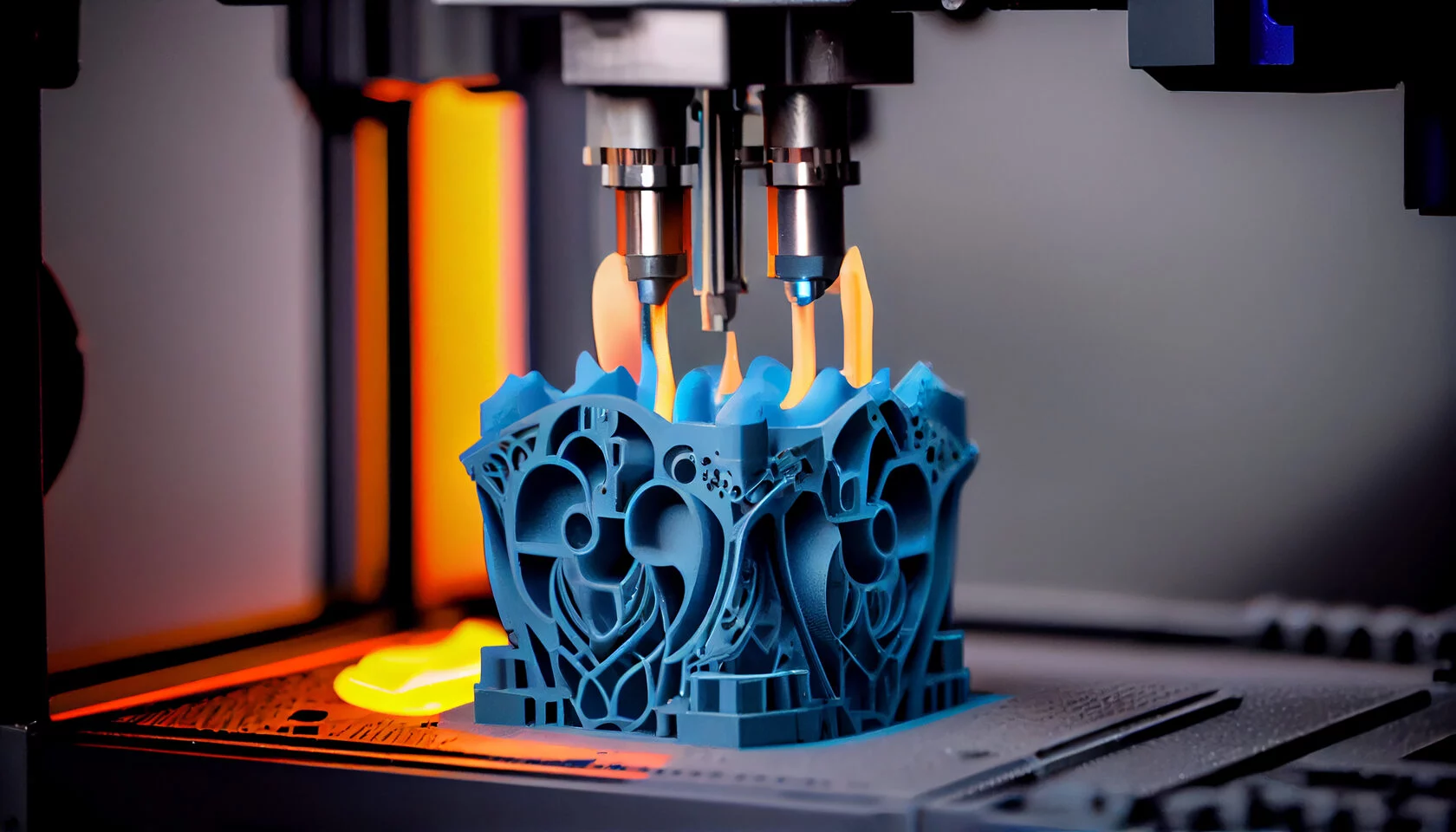
A new technology in manufacturing is 3D printing, which is used to make objects from a digital design. Instead of cutting, drilling, or shaping large blocks of material, as is typical with conventional manufacturing processes, 3D printing typically builds an object layer by layer.
It usually starts with a computer-aided design (CAD) model that is designed digitally. This model is then ready to be put on a 3-D printer that breaks the design into numerous thin layers. The printer lays down, cures, or fuses material, based on digital instructions, until the entire object is created.
Materials may be plastics, resins, metals, ceramics, and special composites, depending on the technology. This versatility allows 3D printing to be applied in various industries from product development and engineering to healthcare and education to architecture and manufacturing.
How Does 3D Printing Change the Product Design?
The freedom that designers have is one of the greatest benefits of 3D printing. Some shapes may be hard or costly to make using traditional manufacturing techniques. Additive manufacturing can enable the creation of complex structures, curves, internal channels, and customized components, with fewer manufacturing restrictions.
The designers are also given more freedom since the creation of a prototype may not need to be done with expensive molds or special tooling. A digital design can be altered and printed multiple times, giving teams a chance to test out multiple prints until they find a final product.
This helps foster innovation. Rather than working around the constraints of conventional manufacturing, engineers can play with new shapes and structures that could yield better functionality, lighter weight, or better looks.
Why 3D Printing is Useful for Rapid Prototyping?
One of the oldest uses of 3D printing technology is rapid prototyping. The advantage of physical prototyping is that product developers can make a physical prototype relatively quickly to test the size, shape, fit, and function.
Problems that may not be evident in a digital model can be identified with a prototype. For instance, a component can fit incorrectly with another component, a handle might not be comfortable, or a product could need structural modifications.
Development teams can skip traditional tooling rebuilds for multiple design iterations with digital designs. Development teams can easily go through several design iterations without having to rebuild traditional tooling. This can significantly reduce product development cycles and allow companies to spot design issues earlier.
How Can 3D Printing Minimize Manufacturing Waste?
In traditional manufacturing, subtractive processes are used in which material is taken off a larger block. This can result in large volumes of waste depending on the product.
The 3D printing method is additive and builds up the object where it is needed. While waste is still a possibility via supports, failed prints, excess resin, etc., additive manufacturing can minimize the amount of material wasted in certain applications.
In cases of high-cost materials and lightweight components, material efficiency can be very significant. Advanced design methods can also be used by engineers to design structures that are strong enough but require less material.
What are the Potential Applications of 3D Printing for Custom Products?
Another great benefit of 3D printing is its ability to customize. Typical mass production systems are designed to make large volumes of uniform products. Producing a new version of each item can lead to higher costs and complexity in manufacturing.
With digital manufacturing, however, designs can be tweaked before the printing of individual objects. This simplifies the method for creating customized products, without necessarily altering the manufacturing process.
Customization can be beneficial for various applications including medical products, consumer goods, clothing, education, and manufacturing parts. For instance, individual measurements, preferences, or functional requirements can be taken into account in the design of the products.
What are the Uses of 3D Printing in Healthcare?
One of the key industries where 3D printing has opened up new possibilities is healthcare. Digital models can be utilized by the medical community and the research for producing anatomical replicas, customized devices, educational models, and even patient-specific parts.
Medical teams can use physical models to gain a greater understanding of complex anatomical structures before procedures. They can also be used in medical education for students to observe detailed physical models.
Customized manufacturing can be especially beneficial when standard products are not suitable to the needs of a particular individual. Additive manufacturing can be integrated into healthcare solutions, according to the application and regulatory requirements.
While the technology continues to evolve, medical applications must undergo rigorous testing, quality control measures, and adherence to relevant safety standards.
Which is More Efficient, Manufacturing with 3D Printing or Without it?
3D printing is a valuable way for manufacturers to create prototypes, specialized tools, replacement parts, and fixtures as well as low-volume products. This can decrease the volume of special parts that have to be carried in stock.
On-demand production can also enable businesses to meet certain demands without having to wait for lengthy production or delivery times. A digital design can be stored and reproduced as necessary as long as the necessary equipment and materials are available.
But 3D printing is not always the optimal solution to every manufacturing job. Depending on the product, the material, the speed, and the quantity, traditional techniques may be more economical in high-volume production.
How 3D Printing is Shaping Architecture & Construction?
Additive manufacturing technologies have also helped in the field of architecture. 3D printed models can be used for designers to visualize buildings, structures, interiors, and complex architectural concepts.
A physical model can be used to convey spatial relationships to a client and project team that cannot be effectively communicated in a 2D drawing. The digital model can be modified by the designer and new versions created as the project progresses.
Additive manufacturing is also being investigated in the construction sector on a larger scale. Specialized systems can process construction material in a layered manner to produce structural elements. The technology is still evolving, but it shows the potential of AM to change future construction techniques.
How Can 3D Printing Aid Education and Innovation?
3D Printing can help educational institutions bring concepts to life. Engineering, Science, Architecture, Art, and Design students can make models and try out prototypes.
This participatory method may help to make technical fields more interesting. Students are able to create an object using their computer, print the object, assess it, and change the design as necessary.
3D printing can also help to promote innovation by reducing the risk of failure. Physical concepts can be tested by small teams, students, inventors, and entrepreneurs without necessarily investing in costly industrial manufacturing equipment.
What are Some of the Challenges Businesses Should be Aware of When it Comes to 3D Printing?
While there are numerous advantages to 3D Printing, there are also some disadvantages. Printing may require slower speeds than the mass production process for large volumes. The types of materials that can be used can also be restricted by the printer and application.
Printed products are affected by the printer technology, material, layer settings, design, temperature, and post-processing. There may be further post-printing processes necessary for some applications.
Equipment costs, maintenance, training of the operators, software requirements, and quality-control procedures should also be taken into consideration. In choosing technology, the requirements of the product and the volume of production must be taken into consideration.
What Would a 3D printing Future be Like?
Several advancements in materials, speed, automation, software, and precision are expected to continue in the future of 3D printing. As AI and digital design grow, it will be easier to optimise more complicated objects for 3D printing.
Distributed production models are likely to be increasingly adopted by the industries, with some parts being produced nearer to the point of use. This may help to save on storage space and perhaps ease certain supply chains.
As technologies evolve, 3D printing can be expected to become more and more part of traditional manufacturing. It is not intended to supplant traditional processes, but will more likely supplement them in applications where customization, complex geometry, speed to market, or low volume production offers a benefit.
What are the Conclusions About 3D Printing?
The 3D printing revolution shows how 3D printing is changing the way many designers, engineers, educators, and manufacturers work and produce their products. Objects can be produced directly from digital designs, which offers possibilities to more rapidly create prototypes, customize objects, design complex objects, and possibly be more efficient in the use of materials.
Although the technology has some drawbacks in terms of cost, speed, materials, and production volume, it is useful for many applications due to its flexibility. With continuing advancements in printer hardware, materials, and software, 3D printing is likely to be a vital aspect of contemporary manufacturing and design.