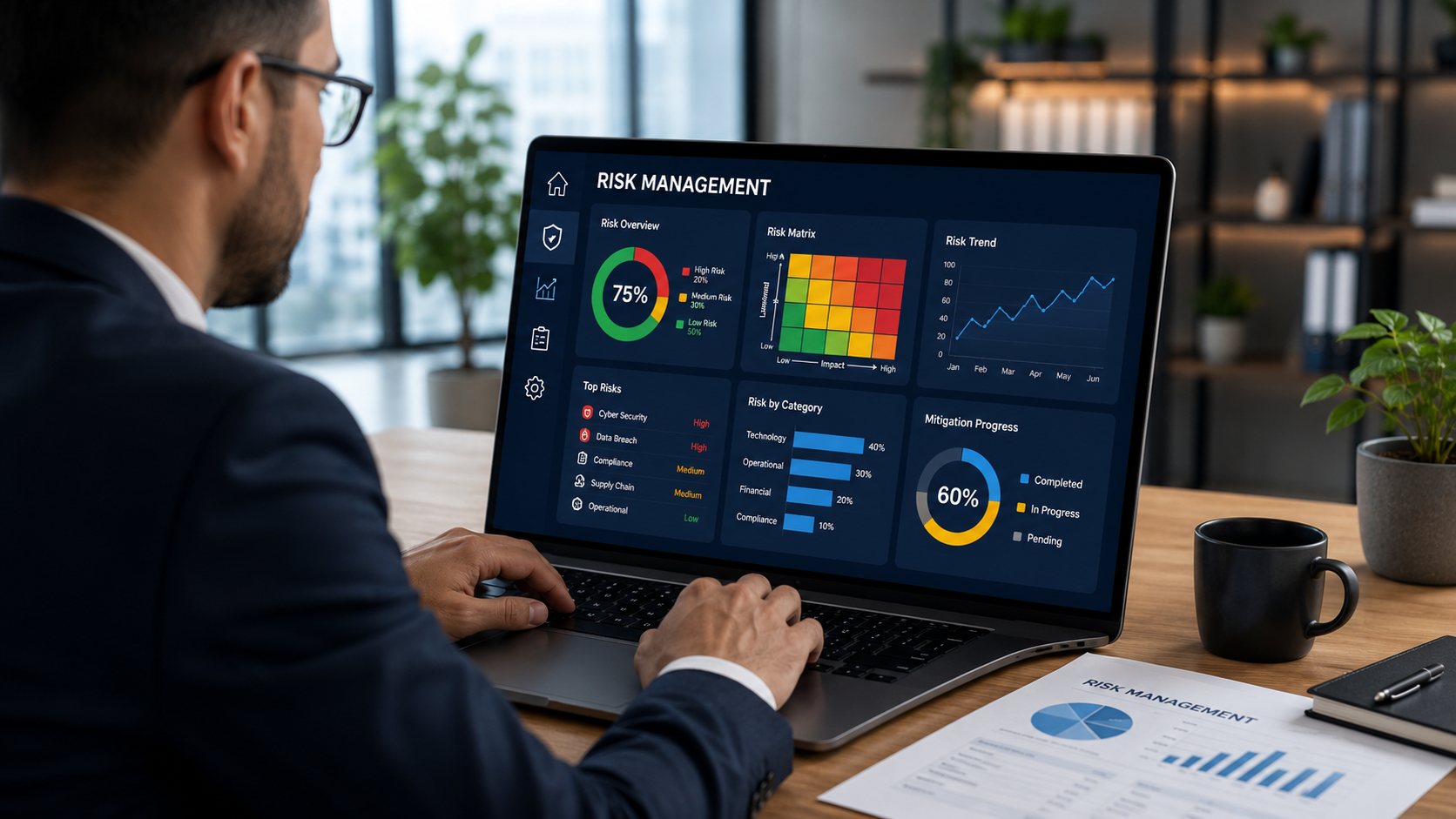
Uncertainty abounds in today’s business world. Threats like network attacks, changes in regulations, financial difficulties, operational issues, supply-chain issues, and reputational damage can impact organizations of all sizes. These risks can be difficult to manage manually as a business expands, with operations becoming more complex. That is where risk management software can prove helpful.
Risk management software will enable businesses to discover risks and track them on a single digital platform. Rather than maintaining spreadsheets and using email or separate documents, companies can have the info regarding risk in a single location. This can help the crew to know what kinds of threats may occur and what to do about them.
Good risk management isn’t just about tackling issues once they arise for modern businesses. It is the art of finding potential problems early, making plans to deal with them, and keeping a close watch on the evolving situation.
How Does Risk Management Software Aid Companies in Identifying Risks?
Risk identification is one of the most crucial roles of risk management software. There are several possible risks in each of the business departments, such as finance, human resources, technology, operations, legal issues, and customer service, etc. that can lead a business to risk hundreds.
Keeping an up-to-date list of these risks might be difficult with traditional methods. Through structured risk management software, companies can list their risks and classify them by their cause, effects, and business implications.
Employees and managers are able to log risks, assign ownership, and include additional information. This provides increased visibility, and it informs decision makers where to focus.
What Role Can Risk Management Software Play in Improving Risk Management?
The first step in identifying a risk is to recognize it. Businesses also must decide how severe that risk might be and how probable it is that it will happen.
Using predefined criteria like probability, financial impact, operational impact, and potential damage to the company’s reputation, risk management software can help teams assess risk. Risk scores can assist organisations in prioritising the issues that need attention now.
For instance, a company could pinpoint multiple risks, but find that one of the cybersecurity risks poses a much greater threat than a lesser operational risk. This then enables the organization to invest accordingly.
Such an organized system can create a more uniform and comprehensible risk assessment experience throughout the departments.
What is the Significance of Centralized Risk Information in Today’s Businesses?
In today’s world, there are usually more than one team, location, system, and business process in a contemporary company. Employees can find it difficult to access accurate and up-to-date information when it is contained in spreadsheets, emails, and on different documents.
This can be resolved by having a centralized platform to compile key risk information. Authorized personnel have access to the relevant records, assessments, action plans, and reports from a single system.
Another benefit of centralization is better collaboration. The risk manager, executive, compliance, IT and department managers can share the same information rather than having to rely on different records.
How Does Risk Management Software Aid Regulatory Compliance?
Compliance with regulations is also a top priority for contemporary businesses. Businesses might have to comply with industry practices, company policies, government regulations, and contract provisions.
Risk management software can help companies identify and manage compliance risks and liabilities. Teams can record controls, track requirements, task people, and track records to help with compliance activities.
It can also be helpful if employees are reminded of key reviews, assessments and deadlines using automation. While software isn’t a requirement for compliance, it can help compliance management be more organized and transparent.
Does Risk Management Software Enhance Decision Making?
Uncertainty is often a part of business decisions. Executives might need to determine if they need to expand to a new market, introduce a product, switch suppliers, switch to new technology, or invest in a large project.
Useful risk information can assist decision makers in making these decisions. Potential threats are easier to understand with risk management software that offers reports, dashboards, risk scores, and trend information.
Leaders can not only make decisions based on assumptions, but can also utilize structured risk information to compare the possible outcomes and create appropriate strategies.
What is the Effect of Automation on Risk Management Efficiency?
Time can be significant when managing risks by hand. Staff can end up wasting hours of their day updating spreadsheets, sending reminders, making reports, and gathering information from various teams.
Some of this administrative burden can be minimized with automation. Organizations can automate notifications, task assignments, risk assessments, reporting, and review schedules based on the platform.
Automation is not meant to take the place of human judgment. Rather, it enables staff to devote more time to risk assessment and solution building and less to repetitive administrative tasks.
Why is Real-Time Risk Monitoring Useful?
Things can change fast. A risk that is not a big threat now may become a serious threat due to market changes, technology advancement, new regulations, and/or internal changes.
A risk management software can offer continuous monitoring features, which enable companies to monitor changes over time. Important changes can be detected on dashboards and alerts to help the responsible teams respond faster.
In fields like cybersecurity, financial risk, supplier management, and compliance, ongoing monitoring can prove to be extremely beneficial.
How Risk Management Software Can Bolster Business Continuity?
Businesses can be disrupted by unforeseen incidents. Productivity/earnings are impacted by natural disasters, cyberattacks, technology failure, supplier disruption, etc.
Business continuity planning is another area that risk management software can aid in, as it can help to document what might happen, who is responsible for what, and what the response is going to entail.
Organizations can employ risk assessments to pinpoint vital business processes and assess if any further security measures are required. This preparation will enable businesses to have a more effective response should the unexpected happen.
What are the Features That Companies Should Look for in Risk Management Software?
Software should be assessed depending on the needs of businesses. Some helpful features include risk identification, risk scoring, dashboards, reporting, compliance tracking, task management, workflow automation, alerts, document management, and access controls.
There may be integration features that are significant as well. A solution that is compatible with current business systems can help to minimize redundant data entry and enhance information sharing.
Another factor to consider is scalability. Instead, companies should look for software or a platform that can accommodate future growth.
How can Risk Management Software Build a Robust Risk Culture?
Senior executives and risk professionals are not solely responsible for effective risk management. Anyone within an organization can pitch in by spotting issues and alerting others to any possible dangers.
A centralized software platform can foster this culture by offering transparency and having processes in place to record and manage risks. Employees can be more proactive if they are aware of the process of reporting and dealing with risks.
This can contribute to the evolution of organisations from a reactive to a more preventive risk management culture over time.
Where Will Risk Management Software be in the Future?
The future of risk management will see more automation, sophisticated analytics, AI, and better business system integration. It is now more than ever that organizations seek to identify possible risks as early as possible and to understand the intricate relationships between risks.
Advanced platforms can be used to process vast volumes of data and uncover trends or patterns that might signal potential threats. But that does not mean human oversight will not be crucial, as, in some cases, business risks are going to be context-dependent, judgmental, and strategic.
With businesses increasingly digitally connected, risk management software is expected to be a growing part of overall business management plans.
Conclusion
In today’s business environment, risk is an inevitable component of business operations. Businesses face a host of potential challenges, including altering regulations, technological threats, operational challenges, financial uncertainty, and so much more. Effective risk management cannot be done on an ad hoc basis or with static spreadsheets.
Risk management software is the collection of programmes that enable enterprises to identify, evaluate, monitor and manage risks in an organized and centralized manner. It can help companies gain greater visibility and make better decisions through its automation, reporting, collaboration, and continuous monitoring.
In today’s day and age, the benefits of risk management software are not just limited to risk recording. It can facilitate more robust compliance processes, communication, preparedness, and more proactively deal with uncertainty. It can also play a significant role in a company’s long-term strategy for resilience and sustainable growth when combined with effective policies and human expertise.
Frequently Asked Questions (FAQs)
So, what’s risk management software?
Risk management software is a computer program designed to aid businesses in identifying, evaluating, tracking, and mitigating risks. It can have a unifying impact on risk data and help with various processes like reporting, compliance monitoring, task management, and risk analysis.
Who is the risk management software for?
Risk management software can be used for organizations of all sizes and industries. Depending on their responsibilities, risk managers, compliance teams, executives, IT teams, finance teams, operations managers, and other employees can use it.
Does risk management software lessen business risk?
While it is not possible to eradicate risk, software can assist an organization in determining the risk earlier, prioritizing the identified risks, assigning them to a team or individual, and tracking the mitigation efforts. These can help with providing improved risk management.
Does Small Business Risk Management Software Make Sense?
Yes. Structured risk management can also be useful for small businesses. There is no one-size-fits-all answer to this, as it will depend on the size of the company, budget, industry, and risk needs of the company.
Does risk management software facilitate compliance?
Many platforms have features to assist organizations in managing compliance requirements, tracking controls, assigning tasks, keeping records, and preparing reports. Organizations are still required to comply with any applicable regulations and standards, however.