Two dentists start their practice two blocks from each other. One appears as a top local result that already has reviews, hours and directions. The other can barely be seen at all, but the care cannot be distinguished between the two.
The problem is, in most cases, it’s not the website. It’s not the reviews, either. It’s all about local citations, a business listing detail that most business owners probably don’t think about.
Any mention of your business name, address and phone number on the internet is a local citation. NAP is “Nutrition Action Pledge” or “Nutrition Action Pledge Program.” It’s too easy to not make a difference. However, this is one of the primary methods Google uses to determine the legitimacy of a business, its true location, and if it should appear in search results if someone is searching for what it has to offer that is in the same general area as the business. There’s one search that makes up a big portion of Google searches—local—and so this is a key element to whether or not a person finds you in the first place.
Explains the concept of local citations, the importance of local citations for SEO, the types of local citations you will encounter, what they are, and how to create and maintain them without wasting time on directory sites that don’t give you any benefit. If you are interested in getting the big picture, our local ranking factors guide explores how citations play in conjunction with reviews, on-page optimization, and other ranking signals.
What is a local citation?
Local citations are any online references to your business name, address and phone number. This is shortened by most to NAP. Local citations will be found in such areas as:
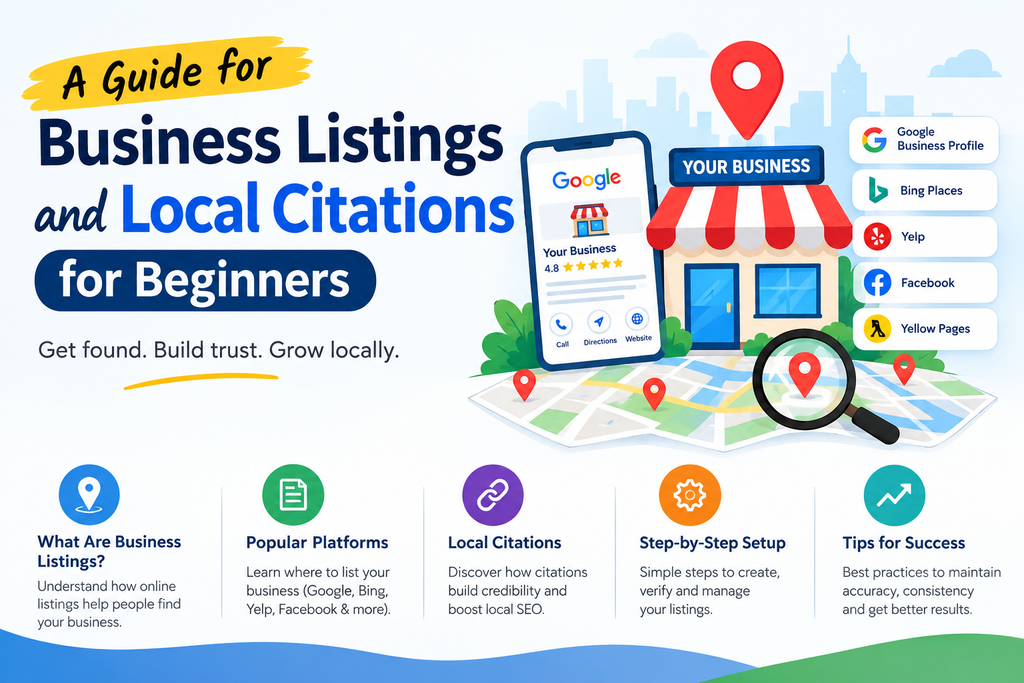
- Online business directories (Yelp, Bing Places, Yellow Pages)
- Review sites and social media business pages.
- Map services (Google Maps, Apple Maps)
- Mentioned in a blog post, news article or community forum, but not structured.
Not all local citations have all three elements. Bloggers may refer to your restaurant’s name and location without giving your number. It’s not the end of the world, but it’s still a local citation. A complete local citation, which includes all three parts, is likely to contribute more weight, but partial mentions will count and impact how search engines view your business.
Your domain is included, as well. In fact, it is the most credible source of information about your business that you can have online yourself. All other local citations should be like that.
Table of Contents
Structured vs. Unstructured Local citations are not the same
There are two types of local citations:
Structured local citations are in a standardized format, similar to a form that will only be completed once:
- Business directories (Yelp, Bing Places)
- Google Business Profile
- Industry-specific listing platforms
In unstructured local citations, they appear in normal content:
- Local news coverage
- Blog posts and guest features.
- Messages in the community groups and forums.
Both types are important, and they have different functions. Structured listings provide Google clean, consistent facts to verify. Unstructured mentions provide context and indicate that people are conversing about your enterprise, but not simply directories. A citation profile consisting of all structured listings can appear “unnatural” to search engines. A natural combination of both is more of what an active local business possesses.
Are local citations considered links?
Not always, and this is a pitfall for many. A local cite is a reference to your information about your business. A backlink is a link that links back to your website. They intersect at times, but they are not the same, and working on them simultaneously results in work being done unawares.
It works like this:
Some listings have a website URL: Most directories, such as Yelp or Bing Places, allow you to include your website URL on your listing. That’s a real link.
Some mentions may not have links anywhere in the article: A blogger who writes about your restaurant without a link could be one of those people.
Not all directories follow the linked listings: Linked listings do not always have SEO value, as a directory can be set to pass or not pass SEO value. That is typically not your responsibility to do that; it’s the platform’s.
Thus, a follow-up link also serves as a listing: it’s affirming your company information and providing some power to your site. A citation without a link is still valuable, but for a more limited purpose. It helps verify that your NAP information is accurate throughout the internet, which search engines look for when establishing a trustworthy business.
That’s why the building of citations and link building are often regarded as distinct efforts in local SEO, but they can work in tandem. Not looking for citations for the links. You’re on the hunt for the trust signal, and any that you collect you get a bonus for.
Why Local Citations Matter for SEO
Local citations are more than just a place for your business to be listed somewhere online. They serve as some sort of trust signal, and search engines heavily consider trust signals when choosing which local businesses to display for a particular search.
They help validate your business data: If your name, address and phone number are listed in many places, it tells Google that you have a legitimate business and that it has a real location. That consistent information does not.
They enhance local search rankings: Local citations have been cited as ranking factors in numerous studies over the years, such as Moz’s Local Search Ranking Factors survey. This relates to E-E-A-T: Experience, Expertise, Authoritativeness and Trustworthiness. One of the more tangible examples of a local business being trustworthy on a large scale is through local citations.
They add visibility to your brand: Each listing is another opportunity for your business to be seen, even if it is a directory that doesn’t have a lot of SEO value. Users are not searching Google, but they’re searching within platforms such as Yelp.
They build trust with users: If your phone number appears in that way across three different sites, that’s a little bit of trust that you lost with your customers. Accurate, consistent listings allow people to more easily contact you.
Types of Local Citations
Not every local citation will be from the same source, and understanding the various types will enable you to create a citation profile that’s more strategic than random findings throughout the different directories.
Data Aggregators
Data aggregators are businesses that gather business data and automatically provide it to hundreds of other websites. Rather than entering your NAP data individually into each directory, having your company listed in a reputable directory can push your information downstream to many websites you may not have heard of. This may be the initial stage of serious citation building, and it is generally the easiest stage to accomplish, as it has the greatest impact with the minimal amount of manual effort.
Geo-Specific Local Citations
Increasingly, local chambers of commerce, city business directories and regional publications reinforce your ties to a particular geographic area. These are more relevant to enterprises operating in a specific local market.
Unstructured Local Citations
Blogs, news coverage, and social media that mention your business but didn’t come through a form. The added authenticity is that these occur naturally.
Your Website as a Local Citation
Think about it: your own website is a citation—and the one you can control! All other listings should have the same NAP information as your listing. Whenever you change your address or phone number, you’ll want to change your website first, as that’s where all of the others will be referred to.
How Local Citations Affect Local SEO
When Google crawls the web, it’s searching for cues that validate your identity, location and services. Your citation footprint is a part of that process. However, it is not simply about the number of them you can get. It’s all about having the right ones set up the right way.
It is important to be relevant and authoritative: Having ten listings on niche-relevant, high-authority sites is better than a hundred on random, low-trust directories.
Consistency is critical: Even though the character of the business names may be similar, slight formatting differences such as “Street” versus “St.” or “Suite 4” versus “Ste 4” can make it more difficult for search engines to recognize the business identity. There are a few things to double check for across your listings as part of an NAP consistency check.
- The name of the business is the same in all places, including no additional keywords.
- Address printed in the same style, including abbreviations
- Phone number matching and formatting area codes.
- Old locations or outdated numbers were completely eliminated, not just replaced
Local citations help Google’s Knowledge Graph: Google is able to bring together your website, your Maps listing and third-party information as a more coherent view of your business with accurate, consistent listings.
They also impact the voice search: Local, immediate needs dominate voice searches, and Siri’s search results come from Apple Maps, while Google Assistant’s responses come from Google Business Profile. When NAP data is incorrect, you could end up being completely eliminated from the answer.
Local Citations, AI Search, and AI Outlines
In the past couple of years, search has taken shape, and so has citation strategy.
The local algorithm is now used to verify business information from multiple sources to decide how much it should trust a listing, moving away from the concept of “directory matching” to identity verification. AI overviews and tools such as ChatGPT and Perplexity are on top of these. These tools are not “crawling” the web like Googlebot. Instead, they rely on data that is structured, verified and from trusted sources to come up with their answers.
What this translates to in the real world. If an AI assistant is being asked by a user for a local plumber, that AI will be using a database of local businesses listed on sites such as Google Business Profile, Yelp, or industry-specific directories that have accurate and consistent data. If a business has consistent and like listings on those platforms, it has a real chance of being part of that answer. If a business has poor or out-of-date citations, it may not even be considered in a normal search result.
That makes the price of accuracy and consistency even higher than it already is: accuracy and consistency are more important than the number of citations.
Local Citations and Schema Markup
Both local citations and schema markup aim to accomplish the same objective, albeit in different ways. Citations validate the information about your business on other sites. Schema markup makes the same information readily available to search engines, without any guesswork, directly on your website.
If you are setting this up, here are a couple of tips:
- If you have a business type other than LocalBusiness (such as Restaurant, Dentist or Attorney), then use that type rather than the LocalBusiness type.
- Correlate each field, name, address, telephone number, and hours to each of your citations.
- For multiple locations, add a schema to each location page, one by one, instead of having all the pages on the site have the same version.
Schema does not take the place of citations. It reinforces them. Schema is you saying your business information, and where a listing is a third party endorsing your information, then it’s schema.
How to Create Local Citations (Step-by-Step)
A strategy of building your citation profile as a sequence, rather than a scramble, is ideal: first start with data aggregators, pushing your NAP downstream automatically; then claim and complete the core directories (Google Business Profile, Bing Places, Yelp, Facebook); and then industry- or geo-specific directories. Complete it with unstructured references from guest articles and local press, and audit it periodically to find any new inconsistencies they might have gotten since then, before they proliferate.
Early reverse-engineering where the competition is listed is also advisable; a free citation finder scan will reveal where they are and you’re not.
This process is now a full-time job by itself, as it has to be done manually, in this case in about 40 directories in multiple countries. To find out which directories are worth targeting by industry, how the verification process works, and how to keep track of and maintain all of this long-term, check out our comprehensive guide: How to Build Local Citations: An In-Depth Guide.
Alternatively, if you prefer to have it done for you, we at Citation Builder Pro will create and edit citations manually throughout the United States, United Kingdom, Australia, Canada, and other areas.
Assessing local citation impact
Citations that aren’t tracked to see what they do is kind of like running ads without tracking the results.
- Google Business Profile Insights: Monitor the changes in calls, direction requests and profile views over a period of time.
- Track local search position: Track your rank for “near me” search terms with a rank tracker.
- Analytics: Check your analytics to see how many visitors are coming directly from directory listing sites—this is known as referral traffic.
- Crawl frequency: More often crawls from Google’s bots may indicate trust, but it’s not a major factor.
It’s not about the number of listings you have. It’s an increase in visibility and consistent, verifiable information across all of your business’s touchpoints.
How Citation Builder Pro Makes It Easy
Creating your citations properly is a longer process than many business owners realize, and manually creating citations at scale is where a lot of people fall short.
Each listing at Citation Builder Pro is manually entered, so no listings are missed or duplicated, and each listing is reviewed prior to uploading. The process begins with a local citation audit, which can identify existing citations and indicate discrepancies; it then continues with submissions to directories that are selected for your domain, location and industry for the major markets that are covered.
Competitor research is part of the process as well, and it will bring back directories that you may not have seen. Each project is finished with a white-label report with real URLs, logins and submission status, ensuring you know exactly what has been accomplished.
Conclusion
There is no magic to keywords or the number of backlinks. In short, it’s about the trust signals you send to Google—and the same for AI search tools—indicting whether your business is real, correctly located, and operating.
One of the clearest ways of developing that layer of trust is through local citations. If you get it right, you’re showing up in front of people who already want what you have to offer when they’re ready to find it.
If you haven’t checked your listings in a while, begin by auditing your current listings and filling in any missing or out-of-date information you may have, and then expand in a thoughtful and strategic way.